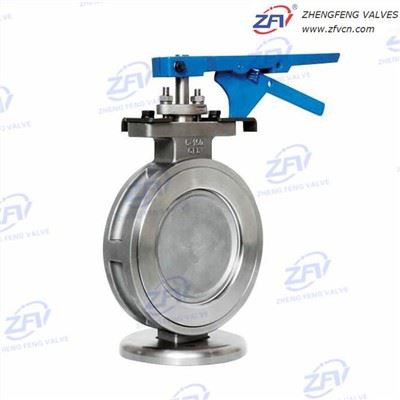
If you’ve ever spent time in a power generation plant – whether it’s a coal-fired facility turning steam into electricity, a natural gas plant keeping the grid stable, or even a combined-cycle plant that blends both to boost efficiency – you know every component has to pull its weight. One part that comes up again and again in our work as a double offset butterfly valve supplier is this: do these valves actually have a place in power plant operations? The short answer is a resounding yes, but there’s a lot of nuance that comes with that. Over the 12 years I’ve been working directly with power plant engineers and maintenance teams, I’ve seen firsthand how double offset butterfly valves solve problems that older valve designs struggle with – but there are also specific use cases where they shine best, and others where careful consideration is non-negotiable. Double Offset Butterfly Valve

First, let’s break down what a double offset butterfly valve is, because not everyone in the power space has time to deep-dive into valve geometry. Unlike a concentric butterfly valve, which has the disk’s centerline aligned with the pipe’s center, and a single offset valve, which shifts the disk’s axis slightly, a double offset (also called high-performance butterfly valve) has two separate offsets. The first shifts the disk’s axis away from the pipe’s center, and the second moves it from the body’s centerline. This design means the disk never rubs against the valve seat when it opens or closes – a game-changer for wear and tear, especially in applications where the valve cycles often. For power plants, that’s exactly the kind of reliability we need, because downtime in power generation doesn’t just cost money; it can disrupt homes, hospitals, and entire industries relying on consistent electricity.
Let’s start with the most common power plant application where these valves work seamlessly: main steam isolation, bypass lines, and feedwater systems. In a coal-fired plant, for example, feedwater pumps push water into boilers to turn to steam, which drives turbines. The lines carrying this feedwater operate at high pressure (often 1,500 PSI and up) and moderate temperatures, but they also cycle regularly – when a plant ramps up output in the morning, ramps down at night, or goes through scheduled maintenance. Older gate valves, which were once the standard for isolation in these lines, have a big downside: their disk rubs against the seat every time they open and close, leading to gradual wear. That means maintenance teams have to remove, resurface, or replace seats far more often, which forces unplanned shutdowns. I worked with a maintenance manager at a 500MW coal plant in Ohio two years ago who told us they replaced their gate valves in three feedwater lines with double offset butterfly valves. The result? Their valve-related maintenance on those lines dropped by 70% in the first 18 months, and they haven’t had an unplanned shutdown from valve failure since. That’s the kind of metric that gets power plant operators’ attention.
Another big use case is in gas turbine inlet and exhaust systems, especially in combined-cycle plants. Gas turbines operate at rapid speeds, and their inlet lines need valves that can handle high flow rates without causing pressure drops that hurt efficiency. Double offset butterfly valves have a streamlined disk design that creates far less pressure loss than, say, globe valves, which means the turbine gets exactly the airflow it needs to run at peak efficiency. I also worked with a combined-cycle plant in Texas that needed valves for their gas turbine exhaust, where temperatures can hit 1,100°F during operation. A lot of lower-quality butterfly valves can’t handle that kind of sustained high temperature, but the double offset design allows for high-temperature seat materials (like graphite or metal alloys) that seal reliably even at those extremes. They swapped out their old exhaust isolation valves, and their turbine efficiency went up by 2.1% – a huge gain for a plant that runs 24/7. That’s real, tangible value that operators can point to in their quarterly reports.
But it’s not just about main lines. We also supply double offset butterfly valves for auxiliary systems in power plants – things like cooling water lines, condensate lines, and air supply systems. Cooling water is a perfect example: power plants use millions of gallons of water to cool down steam after it passes through the turbine, and the lines for this water handle low to moderate pressure, but they cycle often when cooling towers are taken offline for maintenance. Double offset butterfly valves’ tight shutoff (often rated to Class VI leakage, which means almost no fluid gets through when closed) is critical here. If a valve in a cooling water line leaks, it can waste water, increase treatment costs, and even lead to overheating of equipment. A nuclear power plant engineer I spoke to last year told us they switched to double offset butterfly valves for their auxiliary cooling lines because the Class VI shutoff eliminated the small leaks they were dealing with from older single offset valves. For a nuclear plant, where even small leaks can create regulatory headaches, that’s a massive relief.
Of course, double offset butterfly valves aren’t a one-size-fits-all solution, and there are definitely situations where they’re not the best choice. The biggest limitation is pressure and temperature extremes beyond their design range. For example, in a supercritical coal plant, where steam temperatures can hit 1,150°F and pressures over 3,500 PSI, double offset butterfly valves are rarely the right pick – they just can’t handle those ultra-high pressures and temperatures with a seal that’s reliable long-term. In those cases, we typically recommend gate or globe valves, which are designed for those extreme conditions. I always make a point to tell potential clients that even though double offset valves work for most power plant applications, if their system falls into that supercritical range, we’ll be honest about what will work best. Power plant operators hate when vendors push a product that’s not a fit, because it leads to more problems down the line.
Another consideration is valve size. Double offset butterfly valves work great for pipe sizes from 2 inches up to 60 inches, but for larger lines (over 60 inches), sometimes other valve designs make more sense, even if they have higher pressure loss. That said, we’ve supplied valves up to 72 inches for a hydroelectric plant’s penstock lines, and they’ve worked flawlessly for three years now. Hydroelectric plants are another underrated application; their penstock lines carry water from reservoirs to turbines, and the lines are large, often with variable flow. Double offset butterfly valves’ ability to modulate flow (not just open or close fully) makes them perfect for adjusting water flow to match turbine output, which helps hydro plants run more efficiently.
I also can’t talk about power plant applications without mentioning compliance and safety. Power plants have to adhere to strict regulatory standards, from OSHA requirements for equipment to API standards for valve performance. Double offset butterfly valves we supply are tested to API 609, the standard for butterfly valves used in industrial applications, and many are also certified for use in nuclear power plants when paired with the right materials and testing. That’s non-negotiable – no operator is going to use a valve that doesn’t meet regulatory standards, so we make sure every valve we provide comes with full documentation of its testing and certifications.
Over the years, I’ve also learned that the best way to get double offset butterfly valves adopted in power plants is to work closely with the maintenance teams, not just the engineering department. Maintenance managers are the ones who deal with the valves day-to-day, and they care most about downtime and ease of repair. Double offset butterfly valves are far easier to repair than, say, gate valves because their design allows for seat replacement without removing the entire valve from the pipe. I remember a plant in Indiana that was hesitant to switch at first, but when we showed their maintenance team how they could replace a seat in under two hours instead of the eight hours it took for their old gate valves, they were sold. That kind of hands-on, practical demonstration goes a lot further than just talking about efficiency numbers.
Another point that’s often overlooked is cost. When you factor in initial purchase price, maintenance costs, and downtime, double offset butterfly valves are often more cost-effective than traditional valve designs for most power plant applications. Let’s do a quick breakdown: a gate valve for a 12-inch feedwater line might cost $1,800, while a double offset butterfly valve for the same line is around $1,500 upfront. But the gate valve needs a seat replacement every 12 months, costing $800 each time, plus 8 hours of labor to remove and install it, at a maintenance rate of $150 per hour – that’s $2,000 annually. The double offset butterfly valve needs a seat replacement every 5 years, costing $600 and 2 hours of labor – that’s $72 annually. Over 10 years, the gate valve costs $1,800 + ($2,000 *10) = $21,800, while the double offset valve costs $1,500 + ($72 *10) = $2,220. That’s a massive difference, and it doesn’t even include the cost of downtime during those repairs, which can run into tens of thousands of dollars per hour for a 500MW plant.
But I’ll be the first to admit, there are common misconceptions about double offset butterfly valves in the power industry. A lot of people still think they’re only for low-pressure applications, but modern materials and design have changed that. We have valves with metal seats that can handle up to 2,000 PSI and 1,200°F, which is more than enough for most subcritical coal, natural gas, and combined-cycle plants. Another misconception is that they don’t seal as tightly as gate valves, but Class VI shutoff (the highest standard) means they leak less than 0.1 cubic inches per minute, which is almost identical to gate valves for most practical purposes.
So, to circle back to the original question: can a double offset butterfly valve be used in a power generation plant? Absolutely – in most applications, and with great results. But it’s not a one-size-fits-all, and it’s not right for every part of every plant. The key is to match the valve design, materials, and size to the specific operating conditions of the system.
If you’re a power plant engineer, maintenance manager, or plant owner who’s dealing with valve wear, unplanned downtime, or efficiency losses in your lines, I can help. We’ve worked with plants of all types and sizes, from small natural gas facilities to large coal and nuclear plants, and we can provide custom-engineered double offset butterfly valves that meet your specific needs, plus detailed maintenance plans to keep them running smoothly. Don’t waste another dollar on valves that require constant repairs or cause unnecessary downtime – reach out and let’s talk about your plant’s requirements. We can share case studies from similar facilities, walk through design options, and help you find a solution that saves you money and keeps your plant running reliably.
Butterfly Valve References:
- “API Standard 609: Butterfly Valves – Metallic Valves for General Applications,” American Petroleum Institute, 2021.
- “Power Plant Valve Selection: Balancing Performance, Cost, and Reliability,” Power Engineering Magazine, July 2022.
- “High-Performance Butterfly Valves for Power Generation Applications,” Valves and Actuators Magazine, Vol. 28, No. 4, 2021.
- “Nuclear Power Plant Valve Qualification Requirements,” Institute of Nuclear Power Operations, 2020.
Zhejiang Zhengfeng Valve Co., Ltd.
We’re well-known as one of the leading double offset butterfly valve manufacturers and suppliers in China. With abundant experience, we warmly welcome you to buy bulk advanced double offset butterfly valve from our factory. If you have any enquiry about cooperation, please feel free to email us.
Address: Hengtong Road, Wuxing Industrial Park, Wenzhou, Zhejiang, China. 325105
E-mail: sales@zfvalve.com
WebSite: https://www.zfvcns.com/
